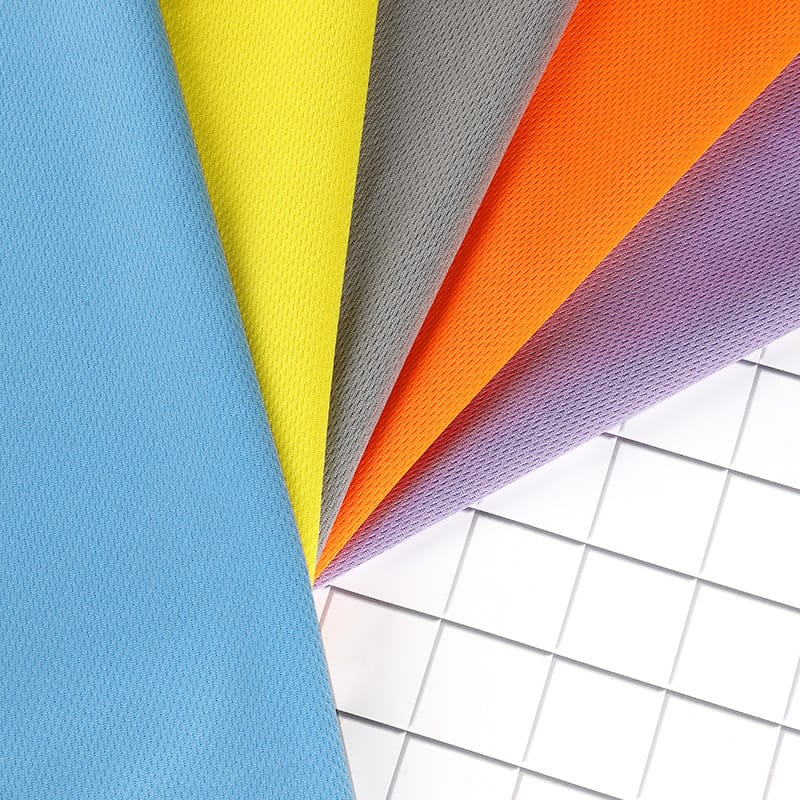
Breathable Fabric for Activewear: CFM Ratings & Air Permeability Guide
Direct Answer
Breathable fabric allows air and water vapor to pass through the material, enabling ventilation and heat dissipation during activity. Breathability is measured in CFM (cubic feet per minute) for air permeability and MVTR (g/m²/24hr) for moisture vapor transmission.
For B2B sourcing, the critical specifications are:
- CFM rating — Higher = more breathable. Mesh: 150-300+ CFM; jersey: 50-100 CFM; dense knits: <50 CFM
- MVTR — Moisture vapor transmission rate. High performance: >15,000 g/m²/24hr; moderate: 5,000-15,000
- Testing standard — Request ISO 9237 (air permeability) or ASTM D737 data, not marketing claims
Breathability hierarchy:
- Maximum (150-300+ CFM): Open mesh, eyelet construction
- High (100-150 CFM): Bird's eye mesh, spacer mesh
- Moderate (50-100 CFM): Pique, textured jersey, fine mesh
- Low (<50 CFM): Dense jersey, compression fabrics, woven
Key distinction: Breathability ≠ moisture-wicking. Breathability = air/vapor movement THROUGH fabric. Wicking = liquid moisture movement ALONG fabric surface. Best performance combines both.
TL;DR — Key Sourcing Takeaways
- CFM is the objective metric: Don't accept "breathable" marketing—request ISO 9237 or ASTM D737 air permeability data
- Construction determines breathability: Mesh > textured knits > flat jersey > woven. Open structures breathe better
- Trade-off with opacity: High breathability often means low opacity—test white/light colors in fitted garments
- MVTR for vapor transmission: Important when fabric is wet (sweat) and vapor needs to escape
- Match to activity: High-intensity sports need 100+ CFM; moderate activity accepts 50-80 CFM
Table of Contents
- Why Breathability Matters for Activewear
- The 6-Step Breathability Selection Process
- Breathability Specification Comparison
- Questions to Ask Your Supplier
- Common Breathability Mistakes
- Related Resources
- About Huada Creation's Breathable Fabrics
Why Breathability Matters for Activewear
The human body generates 500-1,500 watts of heat during exercise. Without adequate ventilation, this heat accumulates, raising core temperature and degrading performance.
The overheating problem:
- Body produces heat during exercise
- Heat must dissipate to maintain core temperature
- Dense fabrics trap heat against skin
- Overheating causes fatigue, reduced performance, discomfort
How breathability solves it:
- Air flows through fabric (convective cooling)
- Water vapor escapes (evaporative cooling)
- Skin-fabric microclimate stays cooler
- Performance and comfort improve
Breathability vs. wicking:
| Property | Breathability | Moisture Wicking |
|---|---|---|
| What moves | Air and vapor | Liquid moisture |
| Direction | Through fabric | Along fabric surface |
| Mechanism | Fabric pores/openness | Capillary action |
| Measurement | CFM, MVTR | AATCC 195 grade |
| Best fabrics | Mesh, open knits | Polyester, nylon |
They work together: Wicking pulls liquid sweat to fabric surface; breathability allows resulting vapor to escape.
The 6-Step Breathability Selection Process
Step 1: Assess Activity Intensity
| Activity Level | CFM Requirement | Fabric Types |
|---|---|---|
| High-intensity (running, HIIT, cycling) | 100-200+ CFM | Mesh, eyelet, open knits |
| Moderate (gym training, golf, tennis) | 60-100 CFM | Pique, textured jersey, fine mesh |
| Low-intensity (yoga, walking, casual) | 40-80 CFM | Standard jersey, interlock |
Step 2: Choose Construction Type
| Construction | CFM Range | Breathability Level |
|---|---|---|
| Open eyelet mesh | 150-300+ | Maximum |
| Bird's eye mesh | 120-180 | High |
| Spacer/3D mesh | 100-150 | High |
| Matte/fine mesh | 80-120 | Moderate-high |
| Pique | 60-100 | Moderate |
| Textured jersey | 50-80 | Moderate |
| Standard jersey | 40-70 | Low-moderate |
| Dense compression | 20-50 | Low |
Step 3: Consider Trade-offs
Breathability vs. Opacity:
- Higher breathability = more open structure = less coverage
- Solution: Test opacity in target colors; use lining panels where needed
Breathability vs. Warmth:
- Breathable fabrics release heat
- Solution: For cool weather, use moderate breathability (60-80 CFM) with moisture-wicking
Breathability vs. Durability:
- Open structures can be more prone to snagging
- Solution: Bird's eye mesh balances breathability with structure
Step 4: Specify Testing Requirements
| Test Standard | What It Measures | When to Use |
|---|---|---|
| ISO 9237 | Air permeability (L/m²/s) | International standard |
| ASTM D737 | Air permeability (CFM) | US standard |
| MVTR / ISO 15496 | Vapor transmission | When moisture vapor escape matters |
Step 5: Match to Garment Zone
| Garment Zone | Breathability Need | Suggested CFM |
|---|---|---|
| Back panel | Maximum | 150+ CFM |
| Underarm | Maximum | 150+ CFM |
| Chest | Moderate-high | 80-120 CFM |
| Sides | Moderate | 60-100 CFM |
| Front body | Moderate | 60-100 CFM |
Step 6: Request Samples and Testing
- ISO 9237 air permeability data
- Opacity testing in target colors
- Comparative samples at different CFM levels
Breathability Specification Comparison
| Specification | Low Breathability | Moderate | High | Maximum |
|---|---|---|---|---|
| CFM Range | <50 | 50-100 | 100-150 | 150-300+ |
| L/m²/s (ISO 9237) | <100 | 100-200 | 200-300 | 300-500+ |
| Fabric Types | Dense jersey, woven | Pique, textured | Fine mesh, bird's eye | Eyelet, open mesh |
| Opacity | High | Good | Moderate | Low (may need lining) |
| Warmth Retention | High | Moderate | Low | Minimal |
| Applications | Compression, cool weather | Year-round training | Hot weather, high intensity | Maximum ventilation zones |
| Huada Products | — | HD8067 Pique | HD8001 Bird's Eye | HD6850 Eyelet |
Questions to Ask Your Supplier
Air Permeability Testing
- What is the tested CFM or L/m²/s per ISO 9237 or ASTM D737?
- At what pressure was testing conducted? (Standard: 100 Pa)
- Can you provide third-party test reports?
Moisture Vapor Transmission
- What is the MVTR rating per ISO 15496 or ASTM E96?
- How does MVTR compare to your non-mesh fabrics?
Construction & Quality
- What construction creates the breathability? (Mesh type, knit structure)
- Is the breathability consistent across the roll width?
- Does breathability change after washing? (Potential for shrinkage closing pores)
Opacity Concerns
- What is the opacity in white and light colors?
- Can you provide opacity test samples?
- Is lining recommended for specific applications?
Practical Performance
- How does this compare to [competitor fabric] in CFM?
- What GSM options are available at this CFM level?
- Are there stretch versions with similar breathability?
- What finishes can be applied without reducing breathability? (Antimicrobial, etc.)
Common Breathability Mistakes
Mistake 1: Accepting "Breathable" Without CFM Data
The problem: Every light fabric is marketed as "breathable." Without testing data, you can't compare or verify. The fix: Request ISO 9237 or ASTM D737 test reports. Compare CFM values across options.
Mistake 2: Confusing Breathability with Moisture-Wicking
The problem: Specifying "breathable polyester" when you need moisture-wicking, or vice versa. The fix: Understand the difference. Breathability = air/vapor through fabric. Wicking = liquid along surface. Specify both for optimal performance.
Mistake 3: Over-Specifying CFM for All Applications
The problem: Ordering maximum-breathability mesh (200+ CFM) for a product that doesn't need it—increasing cost and reducing opacity. The fix: Match CFM to activity intensity. Training wear doesn't need racing-level ventilation.
Mistake 4: Ignoring Opacity in High-Breathability Fabrics
The problem: High CFM mesh in white or light colors is often see-through. Garments become unwearable. The fix: Always test opacity in target colors. Specify lining panels or adjust fabric choice for white/light garments.
Mistake 5: Using Breathable Mesh for Cold-Weather Products
The problem: High breathability releases heat—great for summer, terrible for winter. The fix: Use moderate breathability (50-80 CFM) for cool-weather products. Balance ventilation with warmth retention.
Mistake 6: Assuming Lighter Weight = More Breathable
The problem: Weight and breathability don't correlate directly. A 150gsm dense jersey may be less breathable than a 180gsm mesh. The fix: Compare CFM, not just GSM. Construction determines breathability more than weight.
Related Resources
- Mesh Fabric for Sportswear — Maximum breathability construction types
- Moisture-Wicking Fabric Guide — AATCC 195 testing for sweat transport
- 4-Way Stretch Fabric Guide — Spandex content and recovery
- Pique Fabric Guide — Moderate breathability with structure
About Huada Creation's Breathable Fabrics
Testing: ISO 9237 air permeability testing available Range: CFM options from 50 to 200+ Certifications: OEKO-TEX Standard 100
Breathable Fabric Range by CFM
| Product Code | Construction | GSM | CFM Rating | Breathability Level | Best For |
|---|---|---|---|---|---|
| HD6850 | Eyelet Mesh | 170gsm | 150-180 | Maximum | Ventilation panels, jerseys, high-intensity |
| HD8001 | Bird's Eye Mesh | 135gsm | 140-170 | High | Training tops, team jerseys, polos |
| HD8306 | Matte Mesh | 150gsm | 90-120 | Moderate-High | Premium activewear, yoga |
| HD8067 | Cotton-like Pique | 300gsm | 60-80 | Moderate | Polo shirts, casual activewear |
| HD7928 | Cotton-like Jersey | 170gsm | 50-70 | Moderate | T-shirts, casual fitted |
Get a Quote for Breathable Fabric
Request a Quote — Include target CFM range, construction preference, and application type. We provide ISO 9237 test data on request.
Browse Breathable Fabrics — View our complete breathable fabric range by construction type.