Jersey Fabric for T-Shirts & Activewear: B2B Sourcing Guide
Direct Answer
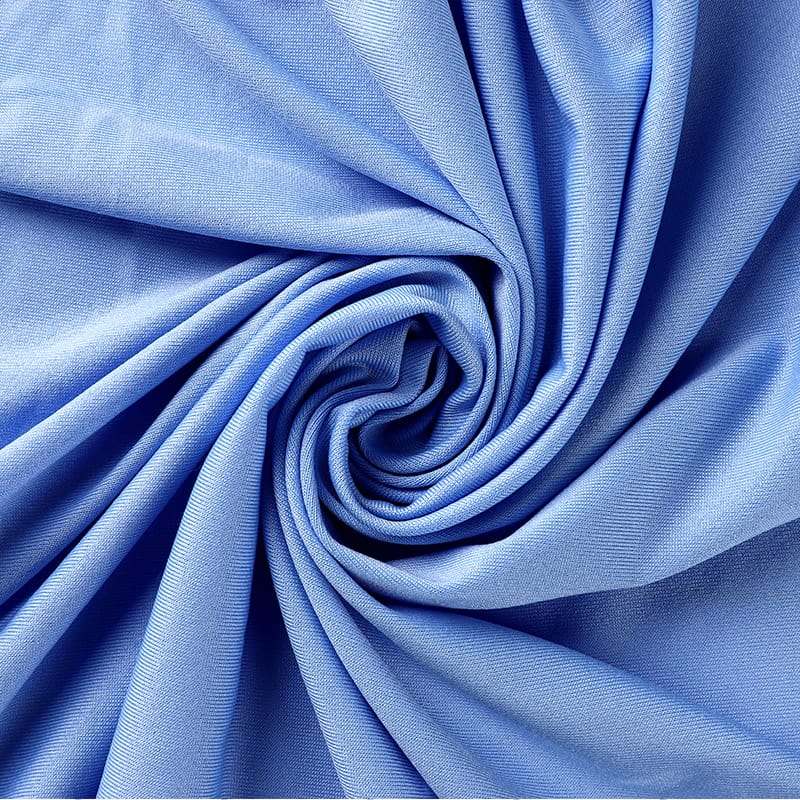
Jersey fabric is a single-knit textile produced through weft knitting, featuring a smooth face (V-shaped loops visible) and slightly textured back (horizontal ridges). It is the most common fabric for t-shirts, casual tops, and lightweight activewear, offering natural stretch (25-40% in width direction), soft hand feel, and excellent printability.
For B2B sourcing, the critical specifications are:
- Construction type — Single jersey (120-180gsm, curls at edges) vs. double jersey (200-320gsm, no curling, more stable)
- Fiber content — 100% polyester for performance and sublimation; cotton-like polyester for softness + performance; add 5-8% spandex for fitted garments
- Shrinkage control — Cotton jersey shrinks 5-8%; polyester jersey <3%; always specify pre-shrinking treatment for sizing consistency
Jersey selection framework:
- Basic t-shirts: Single jersey, 150-180gsm, 100% cotton or cotton-poly blend
- Activewear: Single jersey with spandex, 150-200gsm, 100% polyester
- Structured garments: Double jersey or interlock, 200-280gsm
- Sublimation printing: White polyester jersey, 150-180gsm
TL;DR — Key Sourcing Takeaways
- Edge curling is inherent to single jersey — It's a feature of the construction, not a defect. Switch to double jersey or interlock if non-curling edges are critical
- GSM doesn't equal quality — A 160gsm combed cotton jersey outperforms 200gsm carded cotton; yarn type matters more than weight
- Shrinkage varies dramatically by fiber — Cotton 5-8%, polyester <3%, blends 3-5%. Always specify pre-shrinking treatment
- Spandex changes everything — 5% spandex adds 4-way stretch and improves shape retention, but requires recovery testing
- Sublimation needs specific specs — Only white polyester jersey works; test construction before bulk order
Table of Contents
- Why Jersey Fabric Selection Matters
- The 7-Step Jersey Selection Process
- Jersey Type Comparison Checklist
- Questions to Ask Your Jersey Supplier
- Common Jersey Sourcing Mistakes
- Related Resources
- About Huada Creation's Jersey Capabilities
Why Jersey Fabric Selection Matters
Jersey is the workhorse fabric of the apparel industry—if you're making t-shirts, casual tops, underwear, or lightweight activewear, you're using jersey. The choices you make in jersey specification directly impact:
Customer satisfaction: Wrong weight or fiber content leads to "cheap feel" complaints Production quality: Edge curling causes cutting and sewing challenges Sizing consistency: Shrinkage variance leads to returns and customer complaints Print quality: Wrong construction means sublimation fails or screen prints crack
The core trade-offs:
- Single jersey = lightweight, soft, curls at edges, lower cost
- Double jersey = heavier, stable, no curling, higher cost
- Interlock = smooth both sides, great for baby/sensitive skin, premium cost
Understanding these trade-offs helps you specify the right jersey for your application.
The 7-Step Jersey Selection Process
Step 1: Define Garment Type and Fit
| Garment Type | Recommended Jersey | Why |
|---|---|---|
| Basic t-shirts | Single jersey 150-180gsm | Cost-effective, soft drape |
| Premium t-shirts | Single jersey 180-220gsm (combed cotton or cotton-like poly) | Substantial feel, quality perception |
| Fitted activewear | Single jersey + 5% spandex | 4-way stretch, recovery |
| Structured tops/dresses | Double jersey 200-280gsm | No curling, professional appearance |
| Baby/children's wear | Interlock 180-240gsm | Smooth both sides, gentle on skin |
Step 2: Choose Fiber Content
| Fiber | Best For | Considerations |
|---|---|---|
| 100% Cotton | Natural feel, casual basics | Shrinks 5-8%, wrinkles, slower dry |
| 100% Polyester | Performance, sublimation, durability | Technical feel, potential odor retention |
| Cotton-like Polyester | Performance with soft feel | Best of both worlds, slightly higher cost |
| Cotton/Poly Blend (65/35) | Balance of comfort and durability | Moderate shrinkage, compromise solution |
| Polyester + Spandex | Fitted activewear | Stretch and recovery, requires testing |
Step 3: Select Weight Class
| Weight Class | GSM Range | Best Applications |
|---|---|---|
| Ultra-light | 100-130gsm | Base layers, lingerie, summer basics |
| Lightweight | 130-160gsm | Summer t-shirts, casual tops |
| Medium | 160-200gsm | Year-round basics, activewear |
| Heavyweight | 200-250gsm | Premium t-shirts, structured casual |
| Extra Heavy | 250-320gsm | Sweatshirt jersey, ponte, structured garments |
Step 4: Address Edge Curling Requirements
If edge curling is acceptable: → Single jersey is cost-effective; manage curling in cutting/sewing process
If non-curling is required: → Use double jersey or interlock → Or specify jersey with spandex (reduces curling due to tension) → Or use edge-finishing techniques (binding, coverstitch)
Step 5: Specify Shrinkage Requirements
| Fiber Type | Expected Shrinkage | Mitigation |
|---|---|---|
| 100% Cotton | 5-8% | Specify compacting/pre-shrinking treatment |
| Cotton/Poly Blend | 3-5% | Request shrinkage test data |
| 100% Polyester | <3% | Usually stable; still request test data |
| With Spandex | 2-4% | Test recovery as well as shrinkage |
Always require: AATCC TM135 shrinkage testing on pre-production samples
Step 6: Evaluate Print/Decoration Requirements
| Decoration Method | Jersey Requirements |
|---|---|
| Screen printing | Any jersey; heavier weight (160gsm+) prevents ghosting |
| DTG (direct to garment) | Pre-treated jersey or polyester |
| Sublimation | White 100% polyester only; test opacity first |
| Heat transfer vinyl | Any jersey; spandex content affects adhesion |
| Embroidery | Medium-heavy weight (180gsm+) prevents puckering |
Step 7: Request Pre-Production Samples
Test before bulk order:
- GSM verification (should be within ±5%)
- Shrinkage after 3 home washes (AATCC TM135)
- Colorfastness (AATCC 61 wash, AATCC 16 light)
- Hand feel and drape
- Print test (if applicable)
Jersey Type Comparison Checklist
Use this table when evaluating jersey options:
| Specification | Single Jersey | Double Jersey | Interlock | Jersey + Spandex |
|---|---|---|---|---|
| Construction | One needle bed | Two needle beds | Two needle beds, locked | Single + elastane |
| Weight Range | 120-200gsm | 200-320gsm | 180-280gsm | 150-220gsm |
| Stretch Direction | Width (25-40%) | Both (15-25%) | Both (20-30%) | 4-way (40-60%) |
| Edge Curling | Yes (significant) | No/minimal | No | Reduced |
| Opacity | Lower (depends on weight) | Higher | High | Medium |
| Face/Back | Different (V-loops vs ridges) | Similar | Identical | Different |
| Hand Feel | Soft, thin | Substantial | Smooth, refined | Stretchy, recovery |
| Cost | Lowest | Medium-high | Medium-high | Medium |
| Best Applications | T-shirts, basics, underwear | Dresses, ponte pants, jackets | Baby wear, polos, medical | Activewear, fitted tops |
| Shrinkage (Cotton) | 5-8% | 3-5% | 3-5% | 3-5% |
| Shrinkage (Polyester) | <3% | <2% | <2% | 2-4% |
| Huada Product | — | — | — | HD7928 (170gsm, 95/5 Poly-Spandex) |
Questions to Ask Your Jersey Supplier
Yarn & Construction
- What yarn count is used? (Finer count = 30s, 40s = softer; coarser = 20s = more durable)
- Is this combed or carded cotton? (Combed is smoother, stronger, pills less)
- What knitting gauge is used? (Higher gauge = finer, denser fabric)
- Is this weft-knit or circular knit? (Affects width and production efficiency)
Quality & Performance
- What is the shrinkage rate after AATCC TM135 testing? (Cotton should be <5% if pre-shrunk)
- What pilling grade does this achieve per ASTM D3512? (Minimum Grade 3-4)
- What is your GSM tolerance? (Industry standard ±5%)
- Is the fabric enzyme-washed or peached? (Affects softness and strength)
For Spandex Jersey
- What is the spandex percentage and type? (Lycra, Creora, generic?)
- What is the stretch and recovery rate per ASTM D3107? (Require >90% recovery)
- Does recovery hold after 25 wash cycles?
For Sublimation/Printing
- Is this suitable for sublimation? (Must be white 100% polyester)
- What is the opacity for white garments? (Test required for fitted styles)
- Is pre-treatment applied for DTG printing?
Sourcing & Logistics
- What are MOQs for stock colors vs. custom lab dips?
Common Jersey Sourcing Mistakes
Mistake 1: Treating Edge Curling as a Defect
The belief: "The fabric is defective because it curls at the edges." The reality: Edge curling is inherent to single jersey construction. The face curls toward you at top/bottom edges; the back curls toward you at side edges. The fix: Accept curling and adapt cutting/sewing processes, or switch to double jersey/interlock for non-curling edges.
Mistake 2: Specifying Weight Without Yarn Quality
The problem: A 160gsm carded cotton jersey feels cheaper than a 140gsm combed cotton jersey. Weight alone doesn't predict quality. The fix: Specify yarn type (combed vs. carded), yarn count (30s, 40s), and request hand-feel samples before bulk order.
Mistake 3: Not Accounting for Shrinkage in Sizing
The problem: Cotton jersey shrinks 5-8% on first wash. Without pre-shrinking, a size M becomes a tight S. The fix: Specify compacting/pre-shrinking treatment, or size patterns up 6-8% to account for shrinkage. Always test actual samples.
Mistake 4: Using Single Jersey for White Fitted Garments
The problem: Lightweight single jersey in white is often see-through, especially when stretched. The fix: Test opacity before bulk. Use heavier weight (180gsm+), double jersey, or add lining panels.
Mistake 5: Assuming All Spandex Jersey Recovers Equally
The problem: Cheap spandex jersey stretches but bags out after 5-10 wears. The garment loses shape. The fix: Require ASTM D3107 stretch recovery testing. Quality spandex (Lycra, Creora) provides >90% recovery after 50 cycles.
Mistake 6: Using Cotton Jersey for Performance Activewear
The problem: Cotton absorbs moisture and stays wet. Athletes complain about clammy, heavy fabric during workouts. The fix: Use 100% polyester or cotton-like polyester for any activewear application. Save cotton for casual/lifestyle products.
Mistake 7: Ordering Sublimation on Wrong Jersey
The problem: Sublimation on colored jersey or cotton/blend jersey fails—colors are dull, wash out, or don't transfer. The fix: Sublimation requires white 100% polyester jersey. Always test construction before bulk—some polyester weaves/finishes don't take sublimation well.
Mistake 8: Ignoring Colorfastness for Activewear
The problem: Jersey dye bleeds onto other garments or fades quickly with frequent washing. The fix: Specify AATCC 61 Grade 4+ for wash fastness, especially for dark colors. Request test reports from production.
Related Resources
Continue your knit fabric sourcing research:
- What Is Pique Fabric? B2B Sourcing Guide — When pique beats jersey for polo shirts
- Mesh Fabric for Sportswear — Maximum breathability for athletic wear
- Polyester vs. Cotton for Sportswear — Why polyester dominates activewear
- Understanding Fabric Weight: Complete GSM Guide — How GSM affects performance and cost
About Huada Creation's Jersey Capabilities
Production capacity: 300,000+ meters/month jersey fabric In-house capabilities: Circular knitting, dyeing, finishing, quality testing Certifications: OEKO-TEX Standard 100, shrinkage and pilling testing per AATCC/ASTM
Our Jersey Fabric Products
| Product Code | Construction | GSM | Composition | Key Features |
|---|---|---|---|---|
| HD7928 | Cotton-like Jersey | 170gsm | 95% Poly / 5% Spandex | Ultra-soft hand feel, 4-way stretch, moisture-wicking, sublimation-compatible |
Why HD7928 Cotton-Like Spandex Jersey
This product solves the cotton-vs-polyester dilemma:
- Cotton-like softness — Specialized finishing mimics natural cotton comfort for retail appeal
- Polyester performance — Moisture-wicking, quick-dry, <3% shrinkage, durable
- 4-way stretch + recovery — 5% spandex ensures fitted garments hold shape through wear and washing
- Sublimation-compatible — White base accepts vibrant sublimation prints
- Wide width (180cm) — Efficient pattern cutting, less fabric waste
Testing & Quality
- Shrinkage testing: AATCC TM135 standard
- Pilling resistance: ASTM D3512 Martindale method
- Stretch recovery: ASTM D3107 standard
- Colorfastness: AATCC 61 (wash), AATCC 16 (light)
Sample Availability
- Lab dips: 5-7 business days
- Yardage samples: 1-3 meters, 10-14 days
- Free swatch samples: Up to 5 fabric types per request
MOQ & Lead Times
| Order Type | MOQ | Lead Time |
|---|---|---|
| Stock colors | 500m | 2-3 weeks |
| Custom colors | 1,000m | 4-6 weeks |
| Custom specifications | 2,000m | 6-8 weeks |
Get a Quote for Jersey Fabric
Ready to source jersey fabric for your t-shirt, activewear, or casual wear line?
Request a Quote — Include target GSM, fiber content preference, stretch requirements, and estimated volume. Our team responds within 24 business hours with pricing and samples.
Browse Jersey Products — View full specifications for HD7928 and our complete fabric range.